Paint handling is ok - looser - looser is gooder - less anal than the monstrosly academic early work based on the teachings of some glorified bob ross.here
The new work looks self consciously holly go lighly. .
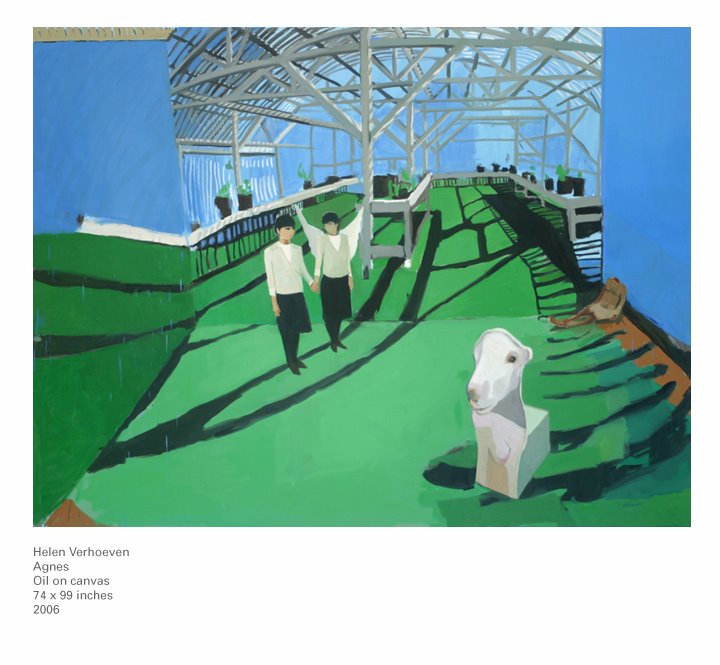
I like Robocop, and I can't help thinking about ecological disaster, something that is close to my heart. When I see greenhouses I think soylent green.
Add a headless ethnic body and the dots start to connect, although I think that's more me -
so I feel like this painting might have content, but I'm not convinced that there's a rich inner life - more a desire for one, appart from, say, Robocop.
But does one need a rich inner life to be an artist? Does Alex Katz?
Does one need to envision a dark dystopian future in order to tap into the zeitgeist? Is there an alternative world where the dark underbelly of society is not laid bare like an open sore for all to see? A world where dark ideas are repressed and emerge like nighmares, an abandoned child's bike with it's front wheel still spinning? A baby carriage with three wheels? A greenhouse filled with light, growing living horse heads in vitamin water?
I like the work on her website a lot. She is very dramatic, and at the same time very loose with her figuration. A lot of her earlier work has a sort of theatric sense that the piece "Agnes" seems to lack. I think that is probably a conscious decision for this painting, and I'm eager to see the rest of the show to find out if this is part of a group of similar paintings.
In "Agnes", she is depicting a starkly different world than she had in much of her earlier works. A painting like "Under Swayne", from her nightmares series, is examining the human ethos of the internal existence, where as "Agnes" seems to be investigating the bland, non confrontational experience of modern life as a whole. Her earlier work was often rooted in the hope (belief?) that we posses something intrinsically spiritual and non existential as humans. That our sadness, our joy and fear are powerful, palpable and real enough to paint. That sense is gone from "Agnes". In this painting, we live instead in an insulated greenhouse, blanketed by our plastic casing from the fervent sky. We are haunted by the lost humanity of our past and the creeping creations of our future. Certainly, this is a painting about the end of the natural, and a good one at that. I think it is particularly effective when one reads back into her earlier work to see her more hopeful paintings from times past.
My word for academics and NY Academy of Art artists is chocolodytes. Because they are all sort of troglodytes and they love the color chocolate brown even though it rarely appears in actual old paintings.
I read the term "deskilling" recently - not sure where, but I've seen it before, elsewhere.
Once uppon a time in Europe artists studied rigourously in academies, where they eventually were given a monopoly on a genere to paint and could then make a living painting cats, for example. You could be the most renound painter of felines and get fat and laid a lot.
Obviously some subjects were more prestigious, and were reserved for the best painters. This is where the term "artistic license" came from. To be a big fat painter of great historical moments as if you were there, would be a sweet gig.
For a more scholarly but brief intorduction see Elkins "why art cannot be taught" - it has a priceless picture of a minimal/conceptual artist staring at the concrete floor instead of the geometric abstractions on the wall.
So you see where I'm headed - between the academy and now, there was a shift in the idea of what "skill" in "art" was.
You may have experienced this split as "hippy dippy" vs. "academic" - where "hippy dippy" teachers think art can't be taught, that it is some innate perceptual instinct, that dogmatic rules ruin you as an artist, that you either have "it" or you're a Nagel, a Peter Max, a George Rodrigue, maker of blue dogs.
The academics will tell you that the reason the afore mentioned artists suck is that they dont know HOW to paint, which is a flat out lie. Anyone can learn to paint.
Anyways, universities across the country hired a bunch of conceptual hacks to teach the bulge of GI bill and student loan funded students. The hack teachers, in turn trained conceptual hacks, and so forth.
The upshot being that urban centers were flooded with newly minted conceptual hack clones.
Thats what I gather, anyways.
In reality I think a lot of smart people got duped by a system that couldn't actaully deliver on the promise.
OA... thanks for the suggestion... maybe i'll pick up his bio on Nathaniel Hawthorne, seems like a good read. Been meaning to check out the biography on DeKooning too.
Several comments say that certain paintings give a nod to or refer to or suggest other artists' work. While everyone is influenced by the work of others, the original artist will not just "nod to" a style. He or she will jump into it full force and push it ahead or improve it in a visionary way. I like art that adds to the pool. Nodding is only about selling.

15 comments:
Helen Verhoeven @
Wallspace
619 W. 27th Street
New York, NY 10001
YAWN
just a gut reaction - so surreally wierdy
Al Held meets Lego-sheep.
blaze
Paint handling is ok - looser - looser is gooder - less anal than the monstrosly academic early work based on the teachings of some glorified bob ross.here
The new work looks self consciously holly go lighly.
.
I like Robocop, and I can't help thinking about ecological disaster, something that is close to my heart. When I see greenhouses I think soylent green.
Add a headless ethnic body and the dots start to connect, although I think that's more me -
so I feel like this painting might have content, but I'm not convinced that there's a rich inner life - more a desire for one, appart from, say, Robocop.
But does one need a rich inner life to be an artist? Does Alex Katz?
Does one need to envision a dark dystopian future in order to tap into the zeitgeist? Is there an alternative world where the dark underbelly of society is not laid bare like an open sore for all to see? A world where dark ideas are repressed and emerge like nighmares, an abandoned child's bike with it's front wheel still spinning? A baby carriage with three wheels? A greenhouse filled with light, growing living horse heads in vitamin water?
Maybe a "Last Days at Marienbad" Campari ad?
Ahh the good life.
i am going to go with comment on genetic engineering for 100
oily, - sounds like a good theory. Resume says academic all over it -
New York Academy of Art, New York, NY (MFA)
For example.
If "de skilling" means anything to you, then you could see why going to a place like that might be good as an antidote
I used to think academic painter people were anal retentives with no content to speak of...now I think its more a matter of taste.
Good and Bad.
Robocop
I like the work on her website a lot. She is very dramatic, and at the same time very loose with her figuration. A lot of her earlier work has a sort of theatric sense that the piece "Agnes" seems to lack. I think that is probably a conscious decision for this painting, and I'm eager to see the rest of the show to find out if this is part of a group of similar paintings.
In "Agnes", she is depicting a starkly different world than she had in much of her earlier works. A painting like "Under Swayne", from her nightmares series, is examining the human ethos of the internal existence, where as "Agnes" seems to be investigating the bland, non confrontational experience of modern life as a whole. Her earlier work was often rooted in the hope (belief?) that we posses something intrinsically spiritual and non existential as humans. That our sadness, our joy and fear are powerful, palpable and real enough to paint. That sense is gone from "Agnes". In this painting, we live instead in an insulated greenhouse, blanketed by our plastic casing from the fervent sky. We are haunted by the lost humanity of our past and the creeping creations of our future. Certainly, this is a painting about the end of the natural, and a good one at that. I think it is particularly effective when one reads back into her earlier work to see her more hopeful paintings from times past.
My word for academics and NY Academy of Art artists is chocolodytes. Because they are all sort of troglodytes and they love the color chocolate brown even though it rarely appears in actual old paintings.
Something about those greens and the way the blue seems luminous that gives a nod to Diebenkorn. Not subject at hand of course but something does..
I read the term "deskilling" recently - not sure where, but I've seen it before, elsewhere.
Once uppon a time in Europe artists studied rigourously in academies, where they eventually were given a monopoly on a genere to paint and could then make a living painting cats, for example. You could be the most renound painter of felines and get fat and laid a lot.
Obviously some subjects were more prestigious, and were reserved for the best painters. This is where the term "artistic license" came from. To be a big fat painter of great historical moments as if you were there, would be a sweet gig.
For a more scholarly but brief intorduction see Elkins "why art cannot be taught" - it has a priceless picture of a minimal/conceptual artist staring at the concrete floor instead of the geometric abstractions on the wall.
So you see where I'm headed - between the academy and now, there was a shift in the idea of what "skill" in "art" was.
You may have experienced this split as "hippy dippy" vs. "academic" - where "hippy dippy" teachers think art can't be taught, that it is some innate perceptual instinct, that dogmatic rules ruin you as an artist, that you either have "it" or you're a Nagel, a Peter Max, a George Rodrigue, maker of blue dogs.
The academics will tell you that the reason the afore mentioned artists suck is that they dont know HOW to paint, which is a flat out lie. Anyone can learn to paint.
Anyways, universities across the country hired a bunch of conceptual hacks to teach the bulge of GI bill and student loan funded students. The hack teachers, in turn trained conceptual hacks, and so forth.
The upshot being that urban centers were flooded with newly minted conceptual hack clones.
Thats what I gather, anyways.
In reality I think a lot of smart people got duped by a system that couldn't actaully deliver on the promise.
Just like at Woostock.
I'm going to buy a book to read today. Any suggestions?
OA... thanks for the suggestion... maybe i'll pick up his bio on Nathaniel Hawthorne, seems like a good read. Been meaning to check out the biography on DeKooning too.
Several comments say that certain paintings give a nod to or refer to or suggest other artists' work. While everyone is influenced by the work of others, the original artist will not just "nod to" a style. He or she will jump into it full force and push it ahead or improve it in a visionary way. I like art that adds to the pool. Nodding is only about selling.
cool)
Post a Comment